

Is it possible to generate an episode in the style of an established comedy podcast using various AI tools and produce a result that sounds as authentic as possible? Driven by this question, the podcast project was born: a collaboration between the entertainment podcast DAS PODCAST UFO and a team from the RHET AI Center at the University of Tübingen.
The project
The emergence of generative AI tools presents new challenges to our society: when we engage with media content and news, the increasing presence of AI-generated content constantly confronts us with questions about the authenticity of the images, videos, audio clips, and voices we encounter online, as well as the intended purpose of this AI-generated content. Where does AI-generated content simulate alternative realities that we do not immediately perceive as such? What content can we still trust and how do we navigate this changed media landscape safely and with awareness? Our project is rooted in the tension between these questions and challenges. As a research center for rhetorical science communication on artificial intelligence, we see it as our responsibility to find answers to these questions in dialogue with society and to provide guidance in the surrounding discourse.
In 2024, we were contacted by the hosts of DAS PODCAST UFO about a collaboration: together, they wanted to create an episode generated entirely by artificial intelligence in their own podcasting style. From a science communication perspective, this was a very exciting project for us: The project aims to explore the limits and possibilities of creative AI generation and co-creative interaction between humans and AI tools, and to further stimulate the discourse surrounding the use of generative AI: Where does the use of generative AI tools make sense, and where does it not? How can consumers recognize AI-generated content? What does responsible use of generative AI look like? How are viewing, listening, and reading habits changing due to these technologies? These are all questions that we as a society must ask ourselves, discuss publicly, and research scientifically.
At the RHET AI Center, we see this project as a unique opportunity to research the field of co-creativity and the aesthetics of impact in AI-generated media content across all stages of production and distribution, and to test the viability of rhetorical strategies when dealing with generative AI. At the same time, this project aims to raise public awareness of the social dimensions of AI-generated content and to foster open discussion on these issues. In particular, we are deeply committed to the topic of competent and responsible use of AI and AI tools, the so-called AI literacy. The podcast project offers an opportunity to explore this topic in a non-academic, entertainment-oriented context together with the hosts and the PUFO community. On Monday, March 16, 2026, listeners of DAS PODCAST UFO had the opportunity to ask the researchers questions about the project and the research during an "Ask Me Anything" session hosted on the podcast’s own Reddit page.
We are happy to have the entertainment podcast DAS PODCAST UFO and its two hosts, Stefan Titze and Florentin Will, as project partners by our side, with whom we can conduct this social experiment and thus perform important pioneering work in the German-language AI discourse.
Goal and structure of the research projekt
The goal of the research project was to create a podcast episode of PODCAST UFO that sounded as authentic as possible using various AI tools. Another podcast episode, in which the project is analyzed, contextualized, and explained, was part of the design from the very beginning.
The entire process of the project is of interest to our work at the RHET AI center. Which criteria does an AI-generated episode need to meet to sound authentic? How can we train generative AI and design a strategic prompting process so that the output is convincing and authentic? How much human influence does this process require, and at which points is this influence particularly necessary? How does an episode like this affect listeners? Where does the illusion break? How do listeners react to the episode after being informed of its AI-generated nature, and what discourse does the project spark? These are some of the questions that arose during the course of the project and which we intend to address in our research.
The work on the project began in January 2025 and proceeded in small steps until the release of the AI-generated episode on March 11, 2026, the scientific observation of the following discourse, and the release of the explanation episode on March 12, 2026.
AI tools used
During the production of the podcast episode, our goal was to generate as many ideas, as much text, and as much audio material as possible with AI tools. To achieve this, we divided the work in four parts and selected a suitable AI tool for each of these steps. We began by transcribing the podcast's audio content to create a text database, which we then used to train another AI tool to generate the episode's text. Finally, we used a third AI tool to generate the audio content for the episode. In addition, a fourth AI tool was used to create a listener's style intro typical of the podcast.
The creation process
Work on the project and the creation of the final product "Experiment" took place in close collaboration with our project partners from DAS PODCAST UFO and unfolded in three phases. During each of these phases, we continuously evaluated our results with Stefan Titze and Florentin Will and adjusted them based on their input.
The podcast episodes (in german)
- AI-generated episode: Experiment
- Resolution/Behind-the-scences episode: UFO506 KI-Experiment Auflösung
Information about the podcast

DAS PODCAST UFO is a comedy podcast that has been succesfully running since 2014. The two hosts, Stefan Titze and Florentin Will, discuss everyday life and the absurd, pop culture, media, and personal observations on a weekly basis. The podcast is known for its improvised segments and a soft spot for the surreal, blending humor and creativity. More information about the podcast is available on the website and the "Pufopedia" (both in german).
Stefan Titze is a screenwriter, producer, and comedian. He was part of the writing team for Neo Magazin Royale and is a co-creator and writer of the multi-award-winning Netflix series How to Sell Drugs Online (Fast). In addition to his work as co-host of DAS PODCAST UFO he is active in various television and streaming productions.
Florentin Will is an actor, comedian and host. He has worked both in front of and behind the camera for Neo Magazin Royale and has appeared in numerous comedy and entertainment shows for television and digital platforms. In addition to co-hosting DAS PODCAST UFO he works as a host and creative at Rocket Beans TV.
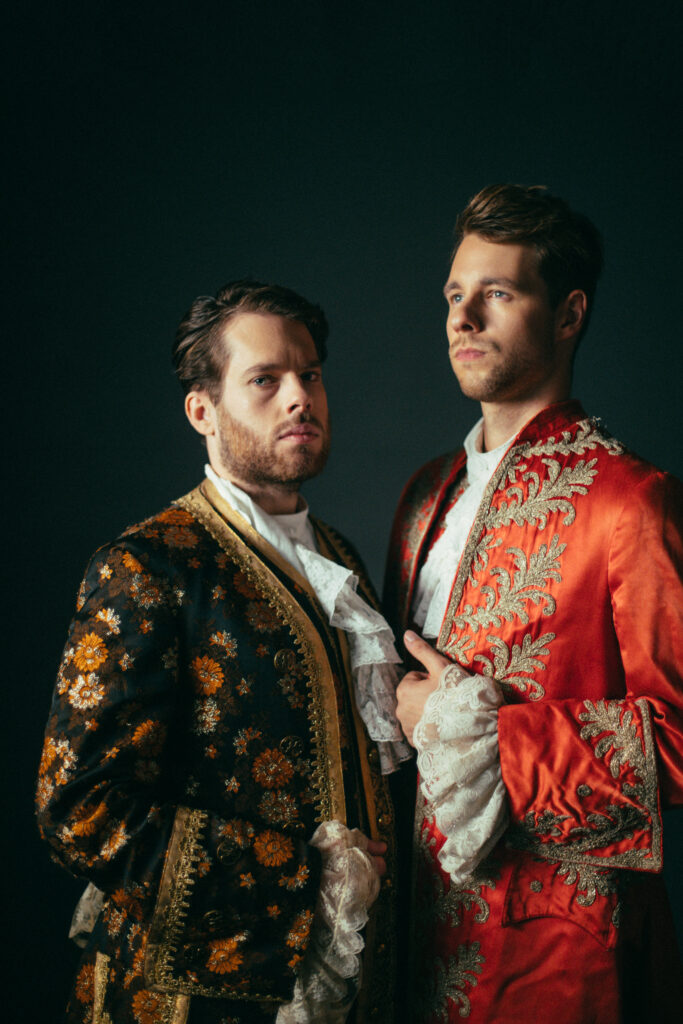
Outside of DAS PODCAST UFO Florentin Will (left) and Stefan Titze (right) also regularly perform together on stage as improv comedy artists. (CC: Joseph Strauch)
Academic publications
Köhler, Anna; Volz, Carolin; Gottschling, Markus (2025): "Wie echt klingt KI?" In: Bieck, Julia; Stavesand, Meena: 10 Jahre HOOU. 10 Stimmen zum Podcasting. S. 59–69. Available online (in german): Digital-HOOU-Podcasts-01-Druckbogen.pdf.
Köhler, Anna; Volz, Carolin (2026): "(Re-)Creating a comedy podcast using Generative AI." Presented at the Symposium Teaming Up with Generative AI: From Tool Use to Partnership. Deutsches Hygiene-Museum Dresden, Germany. March 25 — 26, 2026.
Volz, Carolin (forthcoming): Simulation and Authenticity — Rhetorical Strategies within the AI generated Podcast (working title). Masterthesis in the dregree program Allgemeine Rhetorik (general rhetoric).
Projectlead and contact:

Anna Köhler (01/25 — 03/26)
Project coordinator and Co-Lead
Audio Production; Audio Editing; Organization; Research; Text Generation; Scientific Supervision
Contact: anna-marie.koehler@uni-tuebingen.de

Carolin Volz (01/25 — 03/26)
Co-Lead
Organization; Research; Editing; Text Generation; Scientific Supervision
Contact: carolin.volz@student.uni-tuebingen.de
Vladimir Jakimenko (02/25 — 05/25)
Audio Production; Audio Editing; Research
Alina Habermann (06/25 — 08/25)
Audio Editing
Impressions from the projekt
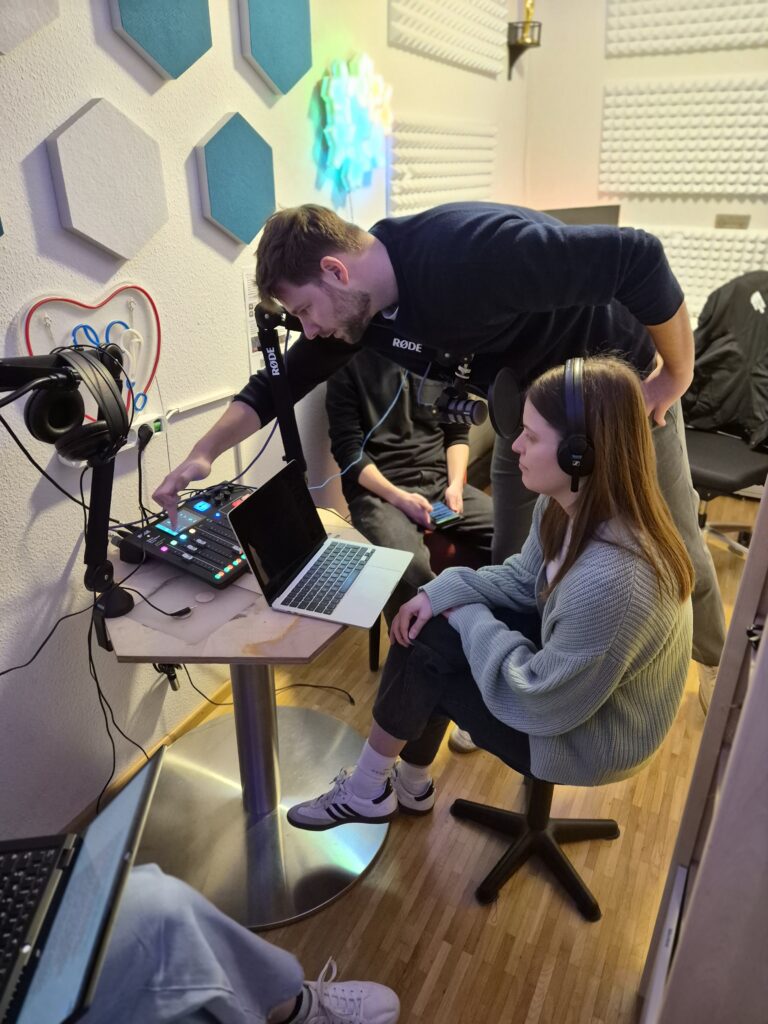
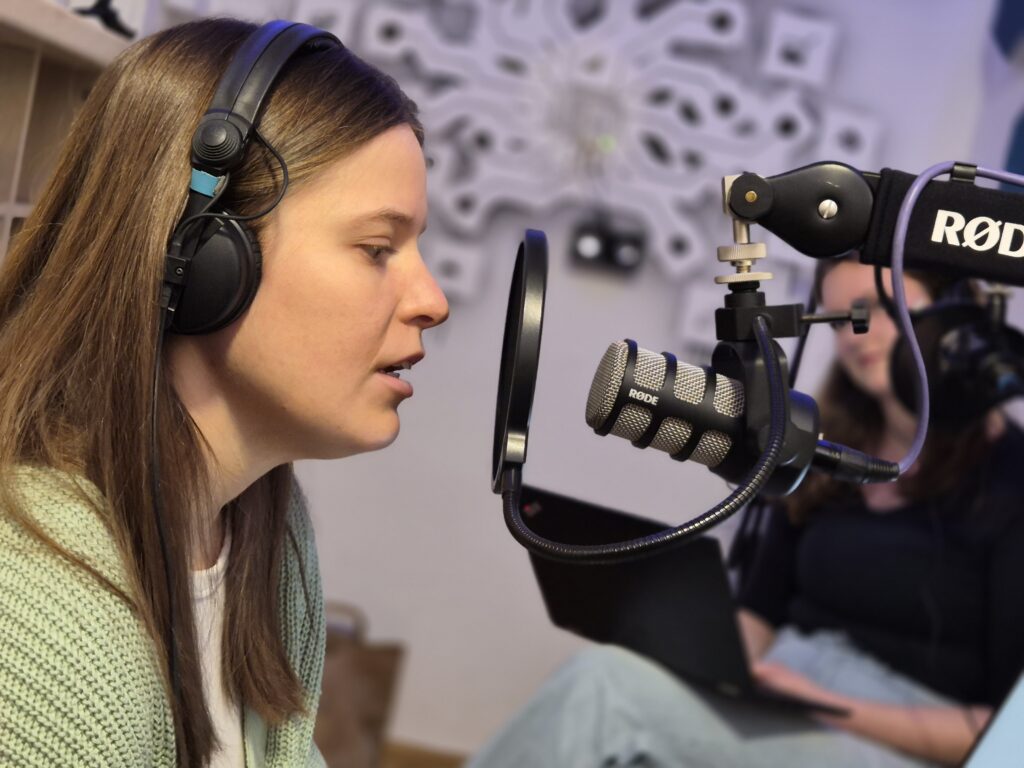
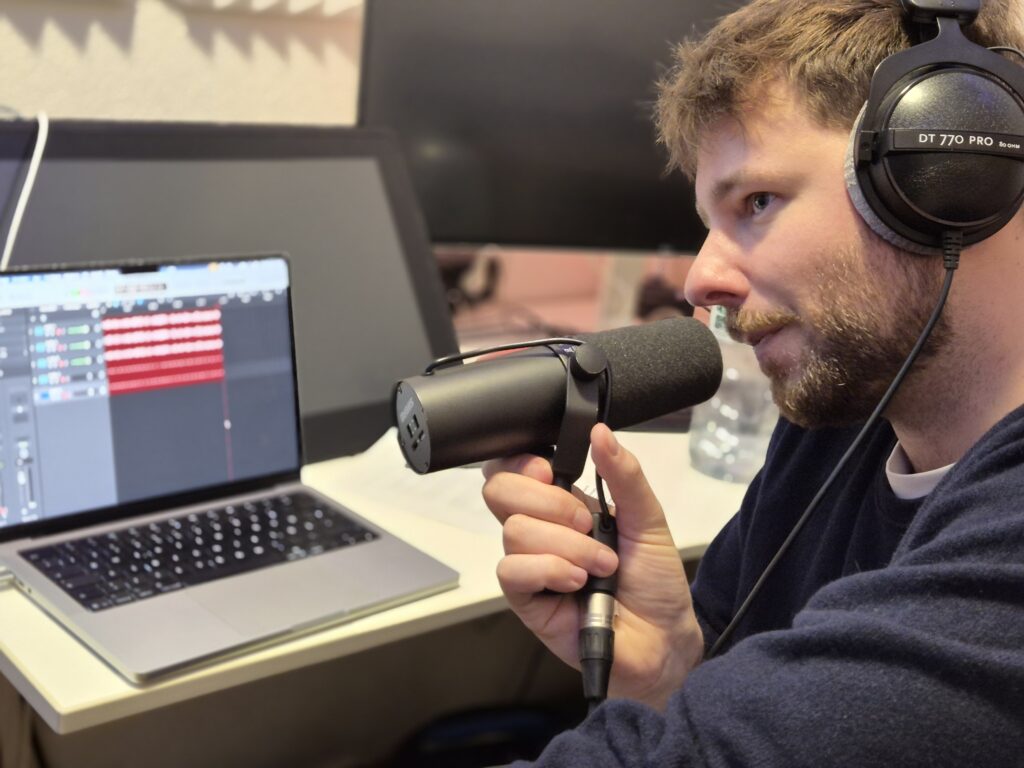

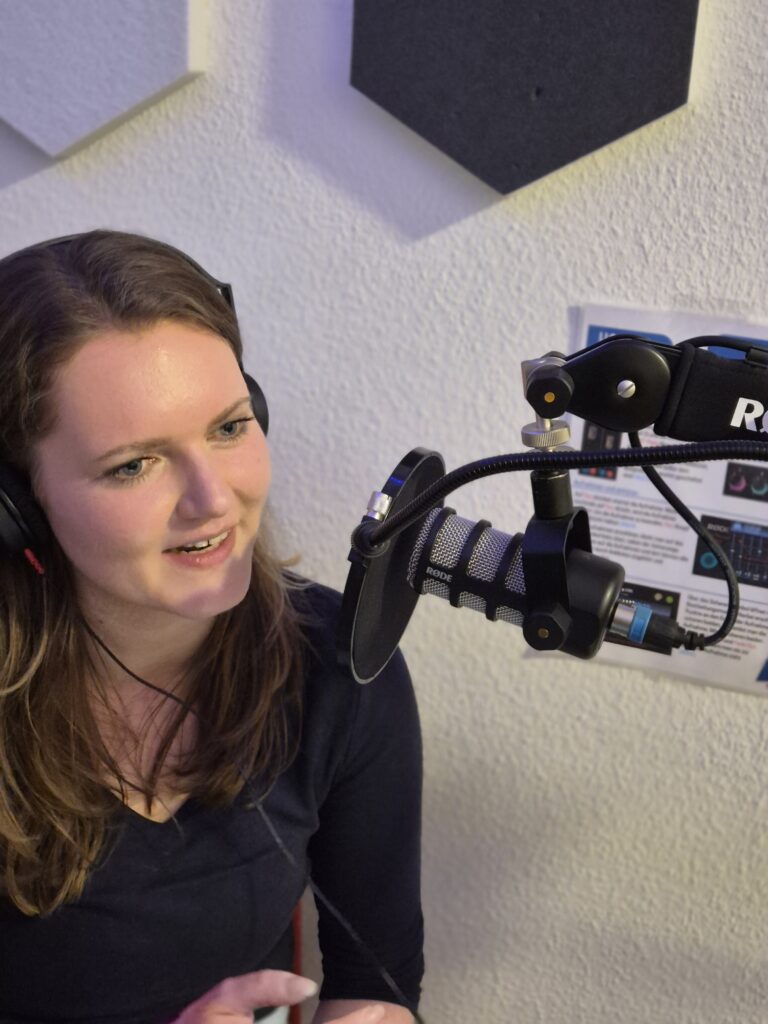
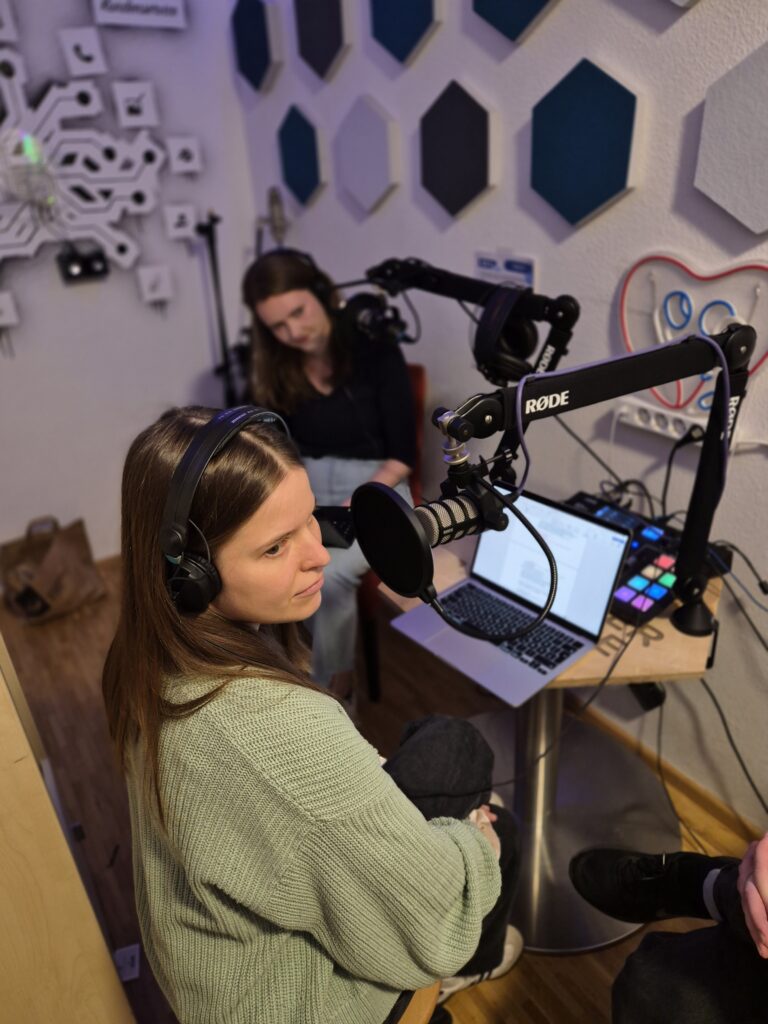
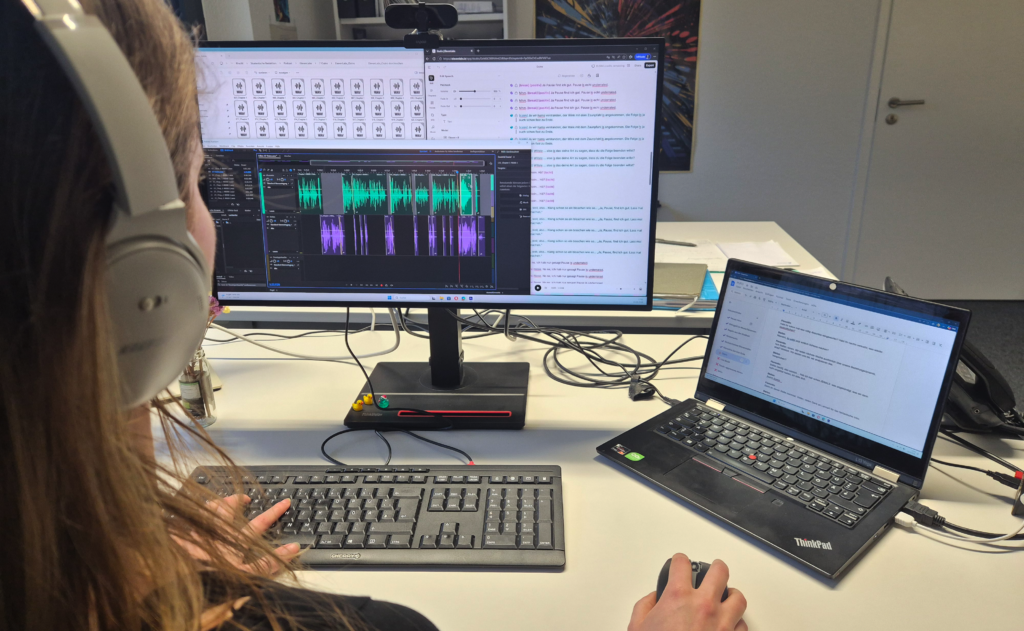
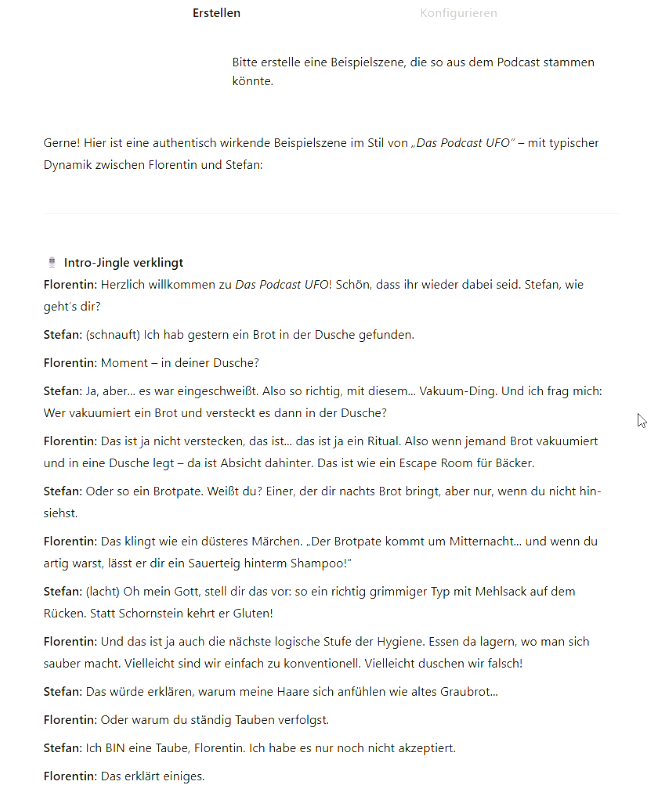
A final Thank You
Huge thanks go to Stefan Titze and Florentin Will from DAS PODCAST UFO for giving us the opportunity to collaborate on this project and for providing us not only with their data and voices but also with the platform to contribute to this important social discourse.
We would also like to thank the KI-Makerspace in Tübingen for providing us with space and equipment to record the resolution episode.
Disclaimer: Fast Forward Science
We submitted the resolution/behind-the-scenes-episode: "UFO 506 KI-Experiment Auflösung" to Fast Forward Science, a science centered multimedia-competition that honours innovative audio- and videocontent regarding academic research.


