

With the "Deus Ex Machina? — Testing AI Tools"-series we want to show you different tools, that aim to simplify writing, design and research by using Artificial Intelligence. More on the "Deus Ex Machina?"-series can be found here.
Overview
"In a society where time is precious and information is everywhere, we want to give our users precise, customized and concise answers." This is the self-proclaimed objective of the Perplexity AI search engine.
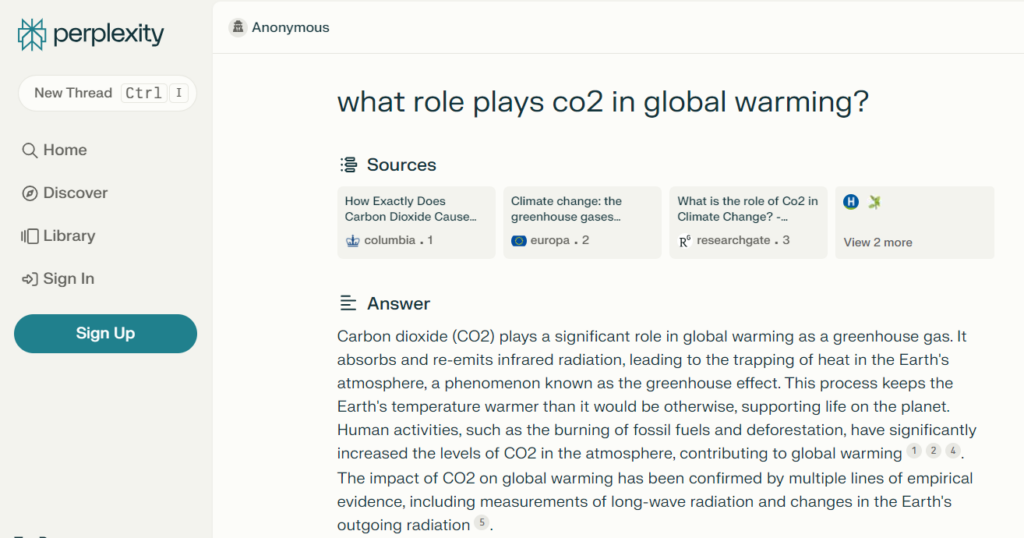
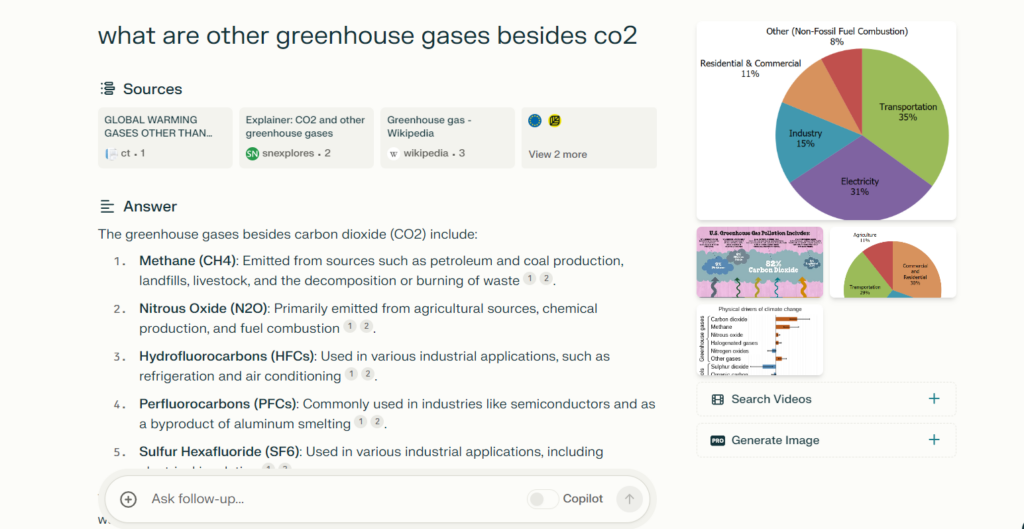
What is special about this search engine is its appearance as an AI-supported chat. You can think of it as a mixture of ChatGPT and Google. Questions can be asked in natural language and Perplexity AI also responds in natural language. To do this, it searches its database and the Internet and compiles a short, concise text from the results. This text is provided with references so that users can see which sources Perplexity used to generate the answers it provided. They also have the option of clicking through to the source website themselves and delving deeper into the topic. In addition, Perplexity suggests further questions after each search query, which can be used to research the topic in question even further. The collected search queries appear as a conversation — similar to ChatGPT — and can be saved and collected. This allows users to access the results again later.
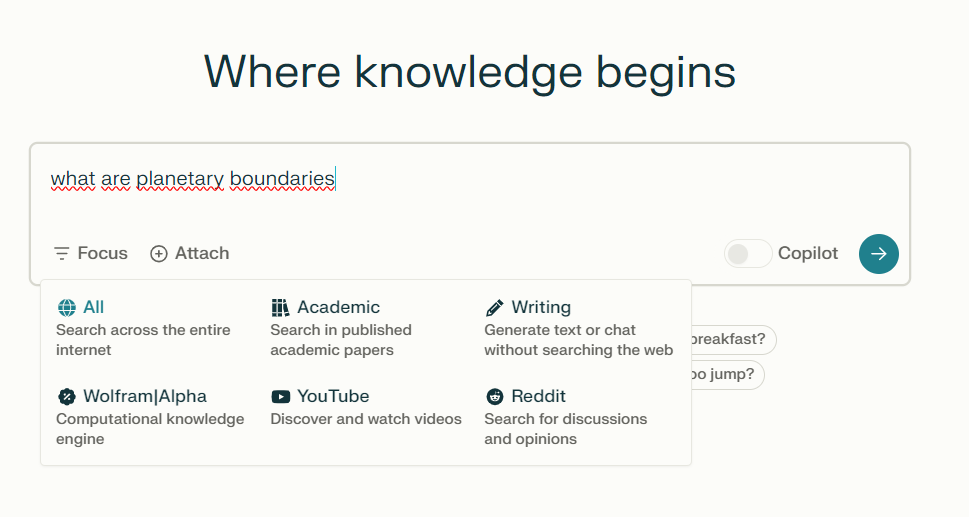
In addition to the general search, users can also specify their search parameters and, for example, specify that only scientific papers, videos or Reddit discussions should be used as a data basis.
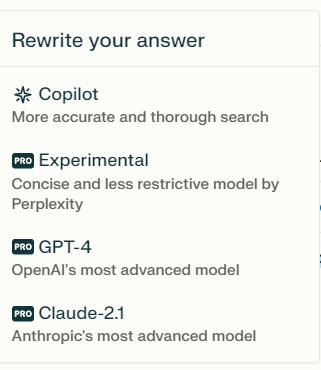
Perplexity AI can be used free of charge and without registration via the browser. Perplexity AI is also available as an app for Android and IOS. When registering via email address, functions such as saving search queries and generating images can be used. Perplexity AI is ad-free, so results are not sponsored. The Pro version of the search engine can be purchased for $20 per month or $200 per year. In addition to unlimited queries, better AI applications and the ability to further personalize the search, Perplexity AI also offers an AI-supported assistant with its Co-Pilot in the Pro Version. It is designed to help deliver the best possible results — for example, by asking users in detail what exactly they want to know.
The AI behind the application
With this new type of search engine, Perplexity AI has entered the field of established search engines as an exciting new player. The company was founded in 2022 by Aravind Srinivas, Denis Yarats, Jonny Ho and Andy Konwinski. In its short company history, the startup has already caused a stir with prominent investors such as Jeff Bezos, Susan Wojcicki and Anderj Karparthy.
The standard version of Perplexity AI is based on ChatGPT 3.5 from OpenAI and combines this AI application with its own large language model that works with natural language processing. However, the company is keeping a lid on the exact functionality of its model. The Pro version includes the newer version GPT 4.0 instead of ChatGPT 3.5, as well as Claude‑2–1 and Gemini Pro AIs from other developers.
Perplexity AI is constantly being updated and expanded. As the company is only at the beginning of its history, it can be expected that its own technology will be further developed and new applications launched in the upcoming years. Perplexity AI utilizes user data to further train its AI, but the company does not specify which data is used for this purpose. This function can be confined in the Pro version.

In June 2024, Perplexity AI's work was criticized on several fronts. For example, Perplexity is said to have repeatedly used and shared media content that is hidden behind a paywall — without the consent of the media in question. It has also been reported that Perplexity AI uses crawlers that violate the so-called Robots Exclusion Standard (robots.txt). With robots.txt, websites can partially or completely block content for crawlers. This is not a binding law, but a kind of code of conduct that reputable crawlers adhere to. CEO Aravind Srinivas stated that the crawler used by Perplexity is from a third-party provider and not Perplexity's own crawler. However, the company did not provide any information about the consequences for the third-party provider. Experts see the Perplexity case as a good example of the problems of current AI development, in which ethical standards and the will to innovate must be constantly reconciled and weighed up against each other.
However, in addition to these copyright issues, other criticisms were also voiced, arguing that Perplexity's answers too often relied on AI-generated content, some of which contained false information and was highly susceptible to so-called "hallucinations", also known as "bullshitting". This is the phenomenon that occurs when generative AIs are asked for answers for which they cannot find sufficient material in their databases and therefore begin to fill the gaps with newly generated information, which is often incorrect. According to research by Forbes magazine, Perplexity AI uses AI-generated sources for every third prompt on average.
The rhetorical potential of the tool
At first glance, Perplexity AI's greatest potential as a search engine lies in the inventio. It helps to find and prepare content. However, by outputting the answers in natural language, Perplexity AI primarily facilitates the transition from inventio to elocutio, as the search engine already formulates the answers in a way that can be used in a text later on. This way, the application gives its users clear examples of how their own text can sound by the end and how the information can be edited. Of course, Perplexity does not take the entire writing process off the user's hands; the person behind the keyboard still has to decide which information is ultimately relevant.
The possibility of a focused search also gives users the opportunity to search for suitable information for different target groups and thus be able to speak to them more appropriately. However, the target group orientation is also a major weakness of the tool. Perplexity AI only provides information in a standardized style that is as close as possible to everyday language. Specific adaptations to other language registers, as required by different target groups, cannot be made. The information provided would therefore have to be rephrased by the users, to be applicable to specific media. For example, if the goal is to create a social media post, the response from Perplexity AI must still be adapted to the highly abbreviated and specific content form of social media platforms.
By citing sources in the search results, Perplexity AI creates more trustworthiness and thus improves the persuasiveness of the content of the text — known as logos in rhetoric. The more logically sound and correctly worded a text is, the more convincing its content will be. According to its own information, the AI is trained to give preference to certain sources that are considered particularly reliable, such as the New York Times. However, this application did not always work reliably in our test. Particularly for niche topics, results from less reliable sources such as Wikipedia were often displayed. The criticism of Perplexity also highlighted the frequent use of AI-generated sources, which in turn are less reliable.
In general, this intended focus on recognized and established media and sources also creates a certain bias in the results. The opinions and realities of life of minorities therefore have less opportunity to be seen. The authority of interpretation in the discourse remains with familiar voices, which further reinforces biases.
Perplexity AI can not only output text, but also images. Pro account users also have the option of having matching images generated for their search queries. If users also want to integrate suitable images into a text to make it more convincing, they do not have to use another tool to do so, but can create text and images that match each other with the help of Perplexity AI.
Usage in science communication
Perplexity AI can be a good partner for science communication, as the tool combines various functions (information search, information processing, image search, image generation) and thus saves users time. By focusing the search on purely academic sources, a higher level of scientific quality can also be guaranteed here than with conventional search engines.
The AI behind Perplexity AI is trained to provide answers that are as comprehensible, precise and concise as possible. Parameters that are also very important for scientific communication. However, the tool's lack of flexibility is not to be underestimated. It is hardly possible to focus the text produced on a target audience with Perplexity AI, but this is essential in science communication. Perplexity AI does not differentiate in its response as to whether information should be understood by a scientific audience, interested laypersons or children. Users must then perform this task themselves in the creation of science communication content.
The criticism leveled against Perplexity AI does not make its use in science communication advisable. Reliability and trustworthiness are elementary factors in science communication. The tool does not appear to be able to guarantee either of these, which is why, despite its generally good structure, it should only be used with caution and not without double checking the content.
Wrap-up
Perplexity AI offers an exciting new way of using search engines and is very suitable for everyday use. It saves its users time and scores points for being intuitive and easy to understand. Even without registration or subscription, the service is helpful and offers good features. By focusing on recognized media and sources, any existing biases are reproduced and reinforced. Perplexity AI is helpful for the everyday work of (science) communicators, but should be used with caution in view of the tool's repeated "hallucinations". In general, Perplexity AI is not a secret magic-tool for science communication: its target group orientation cannot be finely adjusted enough for that. However, it makes the initial steps easier, shows exciting perspectives for further thought processes and can save users time and clicks by summarizing search results. Whether users want to support Perplexity's way of working, which can sometimes be classified as unethical, is ultimately up to the respective users to decide.


