
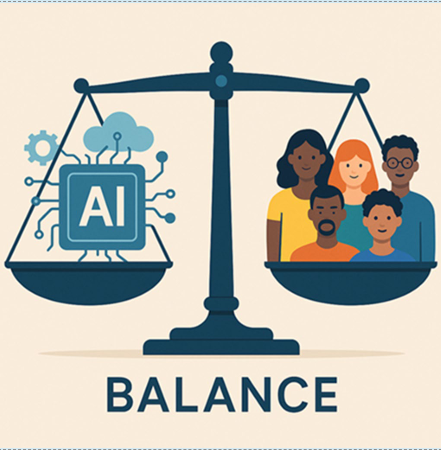
Our colleague Anne Burkhardt, together with Beatrice Bonami (University of Edinburgh, Scotland) and Francielle Vargas (University of Santiago, Chile), successfully established a new working group on „AI & Global Justice“ at the Tübingen Interdisciplinary Centre for Global South Studies (ICGSS).
The working group
In line with the institute's objective of promoting dialogue between researchers, scholars and postgraduates from Africa, the Asia-Pacific region, Latin America and Europe on issues relating to the intellectual challenges of the Global South, the working group focuses on key questions of justice surrounding artificial intelligence in precisely these countries.
Particularly in the context of the Global North, which initially held an economic advantage and superior digital infrastructures, the Global South bears a large share of the economic, environmental and social costs, for example through the extraction of raw materials, inhumane working conditions, data colonialism or the high energy consumption of data centers.
But epistemic justice is also a key focus of the working group: Whose knowledge, languages, values and experiences are represented in AI systems, and which perspectives remain invisible or are marginalized?
Drawing on various empirical and theoretical approaches, such as decolonial theory or diversity-sensitive design, and perspectives from both regions, the group aims to investigate how AI makes global injustices visible, or even reinforces and transforms them. At the same time, approaches to a more globally just use of AI technologies are to be developed. Particular emphasis is placed on voices that are often underrepresented in dominant AI debates, such as women and Indigenous communities.
Events
As an initial highlight, we are pleased to lead a panel at the 7th Annual Conference of the ICGSS from 16 – 27 November 2026 on the topic:
AI, Water and Latin America: Infrastructures, Extractivism and Justice Panel Question What happens when artificial intelligence becomes embedded in water, territories, and the extractive infrastructures of Latin America?
Some of the key questions include:
How does water make AI possible, and how does AI, in turn, change relationships with water?
How do billions of AI queries translate into concrete material demands on water infrastructures?
How do AI infrastructures intersect with extractive and hydrocolonial power relations and structures of exploitation in Latin America?
What can the Amazon and the Atacama Desert reveal about the territorial conditions of today's AI?
How is Indigenous and local knowledge about water represented, integrated or marginalized in AI systems?
Can AI infrastructures be developed in such a way that they are based on reciprocal relationships with water and more-than-human worlds and are more firmly rooted in their respective territories?
A particular highlight is that Paulo Anacé, an Indigenous community leader from Brazil belonging to the Anacé do Kauype people, will be traveling specifically to attend the panel. He is known, among other things, for his work fighting against the water-intensive practices of data centers.
The participants:
Paulo Anacé: "Our Land Is Not a Backyard for Data Centers": Anacé Cosmologies, Spectral Warnings, and the Fight for the Kauipe River
Beatrice Bonami: Material Metabolisms of AI: between water cosmopolitics and data sovereignty and governance in Sierra Nevada, Colombia.
Carlos Gomes: From Water to Data and Affect: Hydrodigital Frontiers, Triple Expropriation, and Ethnoracial Securitization in the Geopolitics of GenAI
Francielle Vargas: Territorializing AI and Large Language Models: Data Centers, Water, and Indigenous Territories in Chile
Anne Burkhardt: Moderation
We are very much looking forward to welcoming interested participants and to many more exciting projects within the working group!


