

Roughly a year ago, the citizens' council "AI and Freedom" met and exchanged views on the role society could play in AI-research and the support of it. Additionally, they discussed the way AI influences our individual and societal freedom.
To the RHET AI Center and especially the Unit 4 (Public Engagement, responsible for the idea and organisation of the citizens' council "AI and Freedom"), this council was an important project, not only in its execution but also in its preparation and the subsequent debriefings.
We interviewed a few colleagues who were involved in various ways in the initial idea and later execution of the citizens' council about their experiences regarding the project. By answering 3 questions, they are allowing us a glimpse into one central topic each which encapsulated them during the process, based on their expertise and their learnings following the course of the project as well.
Patrick Klügel (RHET AI Center Unit 4, Public Engagement Manager at the University of Tübingen) is the first to answer our questions regarding management of expectations. In the following weeks, Anika Kaiser (RHET AI Center Unit 4) will be interviewed on the topic of epistemic injustice and Oliver Häußler (University Communications University of Tübingen) is going to give us an insight into the communication concerning the citizens' council.
Interview with Patrick Klügel
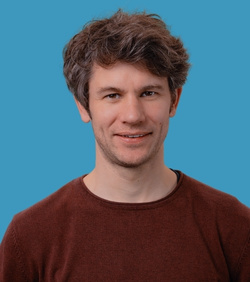
Patrick Klügel is the head of Unit 4 of the RHET AI Center, as well as the Public Engagement Manager of the University of Tübingen.
His expertise covers the design and execution of projects that work with the public, and also the resulting dynamics and challenges. The essence of the particular dynamic which presents itself in participation models such as the citizens' council lies in the merging of different interests.
The individual expectations of participants can differ from what the format may be able to actually offer. Moreover, views can change during the course of the council. We asked Patrick Klügel about these topics:
To what extent do members of the citizens' council view themselves to be in a position of influence on political decision-making?
Patrick Klügel: The citizens' council has neither a mandate nor a claim to directly influence on political decision-making. One could rather say, it was established as an 'inspiring committee' to enrich societal – and of course also political – discourse through socially robust, scientifically informed recommendations. However, a few of the drawn members did indeed develop political self-confidence throughout the process. Some of them act as speakers of the council and represent the recommendations publicly. Others independently met with the mayor of their municipality to report on the council. I would therefore describe it as the members recognising new possibilities following their responsibility in the council.
How did you experience the management of expectations regarding impact and influence on political decision-making while overseeing the citizens' council "AI and Freedom"?
Patrick Klügel: Expectation management is always a difficult balancing-act with these kinds of projects: on one hand, forums with drawn councils base their legitimisation and appeal partially on the idea of giving people without political mandates a special engagement-opportunity. But on the other hand, our citizens' council did not have a political assignment. It wasn't about supporting a legislative process or a specific political decision with a recommendation. From a participations-ethics view, the challenge lied in making it clear that while the Minister of Science of Baden-Württemberg did have an open ear for us, none of the developed recommendations would just be set into practice. This is an important democratic experience, too: to create impact through the shaping of discourse is exhausting, tedious and the result is completely undetermined.
Looking back on the experiences gained from the citizens' council "AI and Freedom", what would you organise differently this time?
Patrick Klügel: I presume that every council-project is so unique in its prerequisites, requirements and course that it becomes difficult to follow a certain scheme. To us, it was very important to be able to make interesting observations regarding our hypothesis on epistemic injustices during the course of knowledge-based deliberation-procedures. If I were to organise any future citizens' councils, I would therefore like to develop and try out other formats and communicative methods concerning 'empowerment' and the activation and reflection of 'knowledge'.
The student editorial team thanks Patrick Klügel for this exciting glimpse into his experiences and is excited to already announce the next interview of this series: we asked Anika Kaiser (RHET AI Center Unit 4) about the topic of epistemic injustices.
Here you can find the other interviews in this series:
- Anika Kaiser (RHET AI Center, Unit 4)
Click here for the interview. - Interview mit Oliver Häußler (Zentrum für Medienkompetenz, Uni Tübingen)
Click here for the interview.


