

European Doctoral Network on Multilingualism, Language Awareness, and Digitalization — Applications for doctoral positions now possible
How is digital transformation changing our awareness of language? What role do multilingualism and linguistic diversity play in social participation and cohesion? And how can challenges such as linguistic inequality, bias in AI systems, or the technological gap between resource-rich and resource-poor languages be addressed?
These are the questions explored by the new European doctoral network MultiLAwa (Multilingualism and Language Awareness in the Digital Age). Funded by the European Union through the Marie Skłodowska-Curie Actions – Doctoral Networks Joint Doctorates (DN-JD) program, the project brings together leading universities and practice partners from across Europe to investigate the interconnections between multilingualism, language awareness, and digital transformation.
International Doctoral Positions
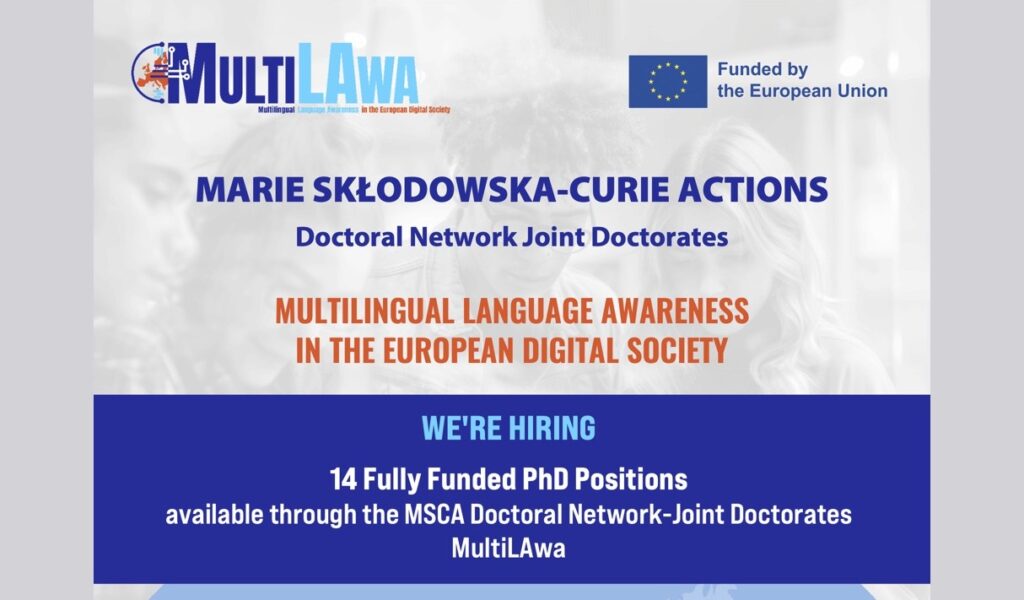
As part of MultiLAwa, 14 fully funded doctoral positions are being advertised for the period from 1 November 2026 to 31 October 2029. Doctoral candidates will participate in a joint doctoral program at two European universities and work in international research teams on topics related to multilingualism, language policy, digital communication, language technologies, and artificial intelligence.
The network connects ten universities with numerous partner organizations from academia, culture, education, and industry. In addition to their research, doctoral candidates will benefit from an extensive training program and international research stays.
For an overview on all open doctoral positions, click here.
RHET AI Center as a Network Partner
The Center for Rhetorical Science Communication Research on Artificial Intelligence (RHET AI) is also part of the network as an Associated Partner. In particular, the Chair of Science Communication with a focus on Linguistics at Karlsruhe Institute of Technology held by Prof. Dr. Annette Leßmöllmann, which has long been engaged in research on language, media, science communication, and artificial intelligence, plays an active role in the project.
As part of the network, the RHET AI Center will host and support researchers from two doctoral projects during their research stays:
Connecting to the RHET AI Center’s Research
Both projects address key research questions that have been central to the work of the RHET AI Center and the Chair of Science Communication with a focus on Linguistics at Karlsruhe Institute of Technology since their inception.
In the context of digitalization and artificial intelligence, language awareness now encompasses far more than traditional metalinguistic competencies. Understanding and shaping digital communication environments increasingly requires media literacy and model literacy as well. This is particularly relevant for science communication: scientific content must be communicated in a linguistically reflective and audience-appropriate manner while also being critically contextualized within AI-supported forms of communication.
At the same time, digital media and AI systems themselves shape societal conceptions of language, knowledge, and meaning. They increasingly function as communicative actors that influence public discourse and thereby contribute to shaping societal language awareness. MultiLAwa therefore provides an important framework for jointly investigating these developments from linguistic, communication studies, and societal perspectives.
Application and Information Event
Applications for the 14 doctoral positions are now open.
Application deadline: 8 July 2026
Online information event:
16 June 2026, 2:00 p.m. (CEST)
Applicants are generally expected to hold a Master’s degree in linguistics, language studies, or a related field. Additional requirements include compliance with the network’s mobility rules and language proficiency of at least B2 level in both German and English.
Contact Persons
RHET AI Center / KIT

Prof. Dr. Annette Leßmöllmann
Lehrstuhl Wissenschaftskommunikation mit dem Schwerpunkt Linguistik, KIT
Unit head, Unit 1: Discourse & Narratives, RHET AI Center
Dr. Monika Hanauska
Akademische Oberrätin
Lehrstuhl Wissenschaftskommunikation mit dem Schwerpunkt Linguistik, KIT
Unit head, Unit 1: Discourse & Narratives, RHET AI Center


Patrizia Attar, M.A.
Lehrstuhl Wissenschaftskommunikation mit dem Schwerpunkt Linguistik, KIT
Unit 1: Discourse & Narratives, RHET AI Center
Project Coordination
Prof. Dr. Hélène Vinckel-Roisin (Université de Lorraine)
Full Professor in German and Contrastive LinguisticsUniversité de Lorraine (Nancy)
UFR Arts, Lettres et Langues

Further Information
- Further information about the project, the doctoral positions, and the application process can be found on the official MultiLAwa project website.
- Additional details on the application procedure and the doctoral network are available here.


