

Ende Juli 2026 ist Dr. Christopher Basgier von der Auburn University (USA) zu Gast am RHET AI und am Seminar für Allgemeine Rhetorik. Über eine neue Lernreihe "Rhetorik, KI und das Lernen der Zukunft" werden künftig Forschende und Praktiker:innen eingeladen, die ihr Wissen in Vorträgen und Workshops mit den Studierenden und Lehrenden der Allgemeinen Rhetorik teilen. Basgier ist der erste Gast dieser Reihe in Tübingen. Er pflegt seit mehreren Jahren gute Kontakte zur Tübinger Rhetorik unter anderem über die RHET AI Coalition. An der Auburn University ist Dr. Christopher Basgier als Director of University Writing verantwortlich für Programme zur Förderung akademischer Schreibkompetenz, fachübergreifender Schreibdidaktik und Schreibberatung.
In Tübingen bietet Chris Basgier zwei Veranstaltungen an: zum einen hält er am 28. Juli im Institutskolloquium des Seminars für Allgemeine Rhetorik einen Vortrag und gibt am 29. + 30. Juli einen Workshop. Wir freuen uns sehr, Dr. Christopher Basgier in Tübingen begrüßen zu dürfen und freuen uns auf die gemeinsamen Veranstaltungen!
Vortrag im Institutskolloquium
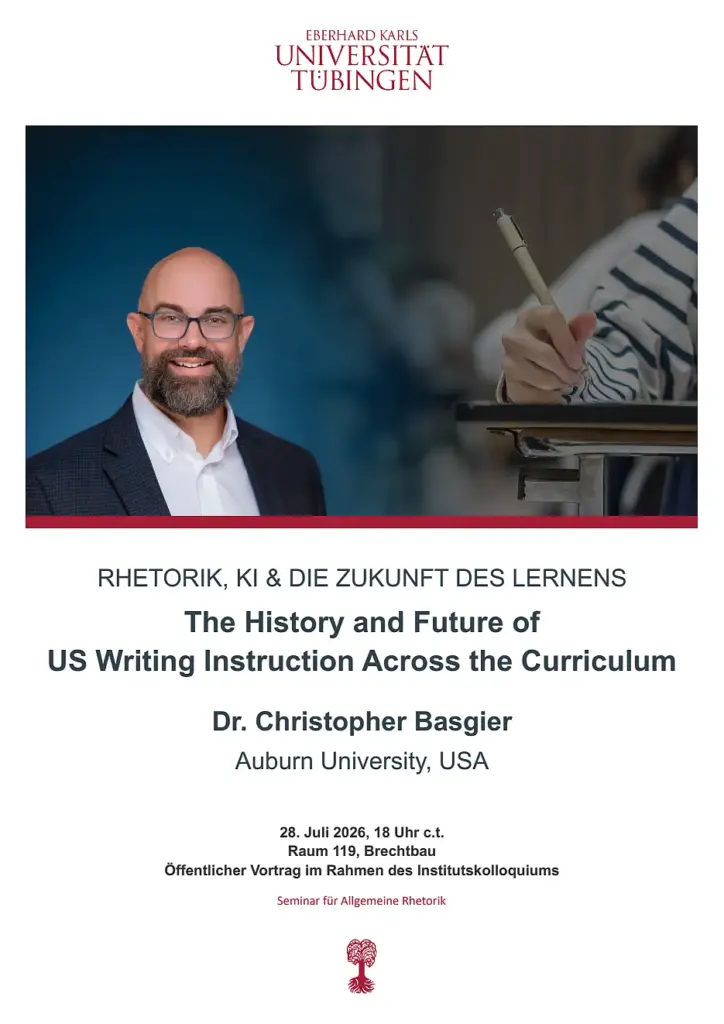
Am 28.07.2026, 18 ct Uhr in Raum 119 im Brechtbau / Neuphilologikum (Wilhelmstraße 50) der Universität Tübingen hält Christoph Basgier einen Vortrag zu
"The History and Future of US Writing Instruction Across the Curriculum"
Der Vortrag zeichnet die Entwicklung der akademischen Schreibausbildung in den USA nach – von der klassischen rhetorischen Bildung über die Ausweitung des Hochschulzugangs im 20. Jahrhundert bis hin zu den aktuellen Herausforderungen durch generative KI. Anhand von Beispielen aus der Auburn University diskutiert Dr. Basgier, wie rhetorische Perspektiven auf Schreiben neue Zugänge zu kritischem Denken, Ethik und wissenschaftlicher Erkenntnis eröffnen können.
Abstract zum Vortrag
In the United States, higher education institutions have developed complex infrastructures for teaching and supporting academic writing. Most first-year undergraduate students take a required writing course that introduces rhetorical conventions and processes of academic writing. Some institutions extend writing instruction beyond the first year via discipline-specific writing courses and professional development in writing pedagogy for faculty in all fields. A majority of US universities also have a writing center, where students can get one-on-one extracurricular tutoring from trained peers who help them respond to writing assignments and rhetorical situations. Furthermore, an entire academic discipline—rhetoric, composition, and writing studies—conducts scholarly inquiry into the teaching, learning, and study of writing. In this talk, Dr. Christopher Basgier will discuss how this complex ecosystem of writing instruction, support, and research came to be, as well as its near future, through the lens of three moments when changing literacy demands reshaped writing instruction: the shift from the classical (heavily rhetorical) curriculum to the modern research university in the late 1800s; expanded access and the revival of rhetoric in the 1960s and 70s; and the rapid development of generative artificial intelligence (genAI), which challenges existing assumptions about writing instruction. Using professional development programs at Auburn University as illustrations, he will argue that rhetorical ways of thinking about writing can help faculty across the disciplines reimagine the relationships among writing, critical thinking, ethics, and inquiry.
Seminar: Writing and GenAI – Myths and Realities
Am 29. + 30.07.2026, jeweils von 9–17 Uhr, gibt Chris Basgier Einblick in das Schreiben mit generativer KI und räumt mit einigen Fehlvorstellungen und Missverständnissen auf. Unter Rückbezug auf antike Rhetorik- und Schreibforschung reflektiert Basgier mit den Studierenden über die Funktion des Schreibens für die Wissensbildung und den Umgang mit KI-Tools im akademischen Alltag.
Abstract zum Seminar
Many common myths about writing are intensifying and changing in the wake of generative artificial intelligence (genAI). For example, writing is often treated as a transparent carrier of meaning, an assumption that may seem plausible when a large language model (LLM) appears to “understand” a prompt. However, the fields of rhetoric and writing studies see it differently: writing is a social, rhetorical, and knowledge-making activity (and not just an automatable process). At the same time, the technology has introduced new myths, including the idea that LLMs “think” like humans. In this short course, we will examine such myths, discuss more productive ways of understanding writing in the age of genAI, and consider how rhetorical concepts can help us respond critically to the technology as writers. Students will analyze academic essays about writing and genAI, reflect on their own practices as writers, and write a provisional, personal ethics statement about genAI use in academic writing, the professional world, and life.


