
New Working Group "AI and Justice"
Our colleague Dr. Anne Burkhardt, together with Dr. Beatrice Bonami (University of Edinburgh, Scotland) and Dr. Francielle Vargas (University of Santiago, Chile), successfully established a new


Our colleague Dr. Anne Burkhardt, together with Dr. Beatrice Bonami (University of Edinburgh, Scotland) and Dr. Francielle Vargas (University of Santiago, Chile), successfully established a new

AI for Good: Global Responsible Innovation and Business Transformation Dr. Anne Burkhardt will represent the RHET AI Center from 24–27 September, 2026 at the Brazilian-German

European Doctoral Network on Multilingualism, Language Awareness, and Digitalization — Applications for doctoral positions now possible How is digital transformation changing our awareness of language?

In press Burkhardt, Anne; Marschall, Susanne; Kramer, Olaf (Hg.) (im Erscheinen): /Artificial Turn? Interdisziplinäre Perspektiven auf Künstliche Intelligenz./ Freiburg: wbg/Herder. Kohmann, Lukas; Mirsky, Ilja (i.E.):

This week, the new Journalists-in-Residence, Dr. Anna Henschel and Willem de Haan, start their research residence Tübingen. Anna Henschel works at wissenschaftskommunikation.de (eng.: science communication)

On this page we will collect all news about the new GAL research focus "Artificial Intelligence"e future. What is the research focus "Artificial Intelligence"? The

Artificial intelligence occupies our society. This is not news, but can be seen in the most diverse areas of everyday life. For example, through the

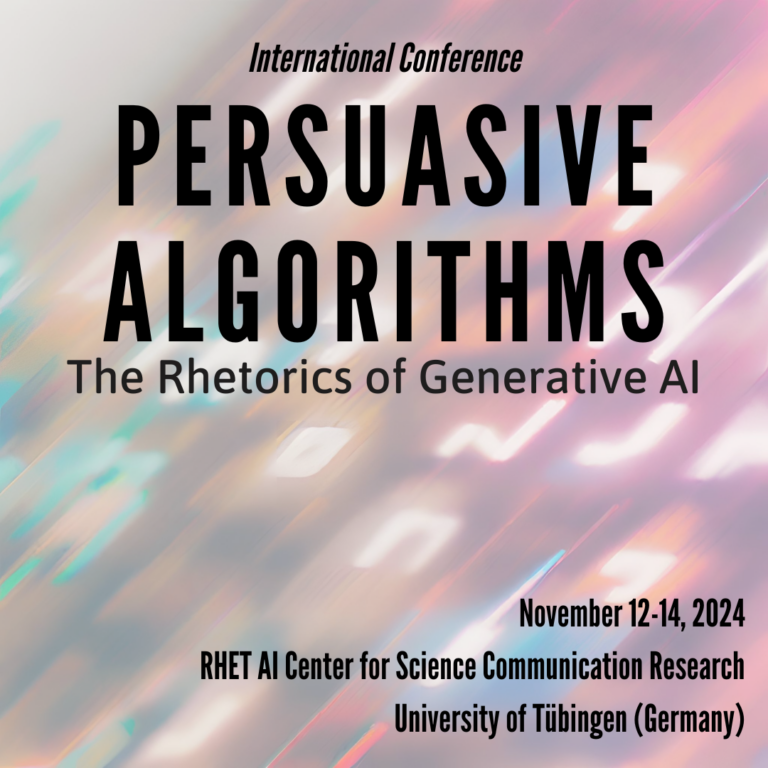
International Conference "Persuasive Algorithms? — The Rhetorics of Generative AI". The Center for Rhetorical Science Communication Research on Artificial Intelligence (RHET AI) in cooperation with

The sixth Artificial Friday during the Winter Semester 2024/25 goes international — on four dates we welcome researchers from South Africa, Ireland, Spain, Denmark, Australia

The anthology Artificial Turn — Interdisciplinary Perspectives on Artificial Intelligence (ed. by Anne Burkhardt, Susanne Marschall and Olaf Kramer) provides an overview of the research